In this article
A scheduled eight-hour shift, a note about eight hours on site, and eight hours on a pay statement may look like the same fact. They answer different questions. Keep all three visible until you know which comparison is valid.
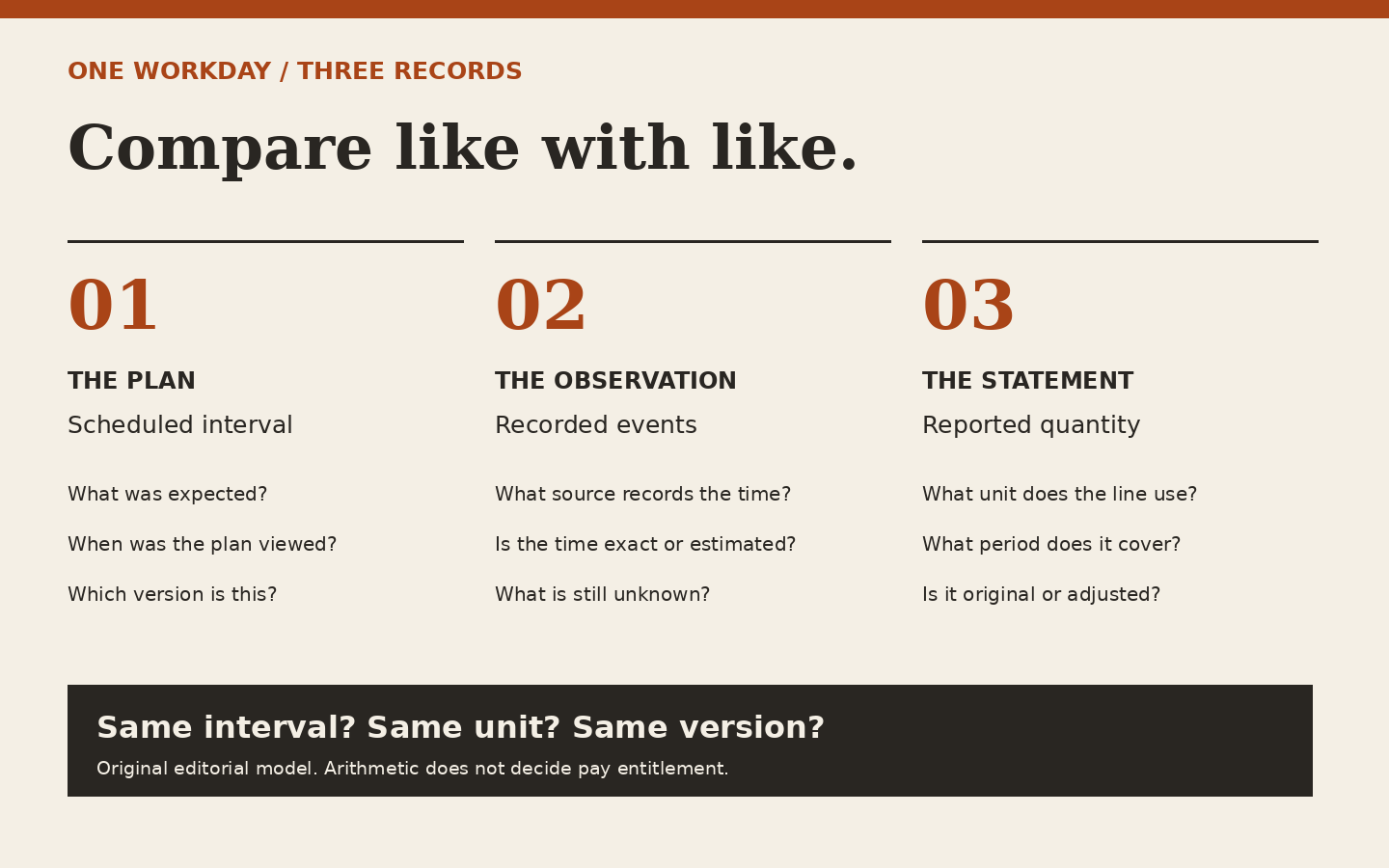
First column: the plan
A schedule describes an expected assignment at the time it is viewed. It can be an important starting point, but its existence alone does not establish attendance, the final time record or payment. Give a saved schedule a viewing date. A later view may differ without telling you when the difference was made or who authorized it.
Allied Universal’s public Earn More page describes shift opportunities in LISA. That establishes a public use of the service; it does not establish that a particular shift is available, accepted or completed for you.
Second column: observations about the workday
Use the records you are allowed to keep: an existing time record, your contemporaneous note, or a permitted confirmation. Record what each actually says. An arrival time is not automatically the same thing as a recorded start. A remembered departure is not automatically an accepted clock-out. If a time is an estimate, label it as an estimate rather than making it look exact.
Keep the original and your interpretation separate. You can annotate a private working copy with a question, but do not change the source to make it match the story. Avoid copying client-site details, coworker information or operational reports into a personal collection. A time question rarely requires that entire record.
Third column: the payment record
A pay statement belongs to a period and a payment date. Its line labels matter. A quantity could be regular hours, a different earning category, an adjustment, or something that is not measured in hours. Read the unit before comparing the number with a duration. Allied Universal’s Login Portal points employees to eHub for schedules and pay stubs; this publication cannot retrieve either.
Treat the period and issue date as separate fields in your own comparison. One locates the work being discussed; the other locates the statement you are reading. A useful question names both.
A fictional comparison that stays open
What a completed comparison looks like
You should be able to point to the source, its date or version, its unit, the period it covers and the remaining uncertainty. If any of those is absent, keep a visible “not yet matched” note. That is more reliable than forcing all three columns to agree. Use the interval workbench for simple time arithmetic and the notation guide before comparing an hour quantity.
Sources and limits
Public-source review: October 16, 2026. The reasoning and fictional examples above are editorial analysis; no private account, payroll record or authenticated interface was examined.
- Earn More. Your Way. — Public description of LISA shift opportunities and a company-owned link to its portal. Not a guarantee of a particular offer or account feature.
- Allied Universal Login Portal — Public employee entry list; eHub is described as a route to schedules, pay stubs and contact updates. No private screen reviewed.